
To'a Kaninã
Director:
Fernanda Amim and Renata Tupinambá
Producer:
Micael Hocherman and Gabriel Corrêa e Castro
Production company:
Cardume Filmes and Viralata Produções
Production country:
Brasil
Duration in minutes:
90
Contact:
Sinopsys:
In To’a Kaninã, Cleonice Pankararu and Uakyrê Pankararu fight to resist a new wave of colonization and protect their territory from large multinational corporations that have invaded the Jequitinhonha Valley in search of lithium. While politicians and financial market agents use the climate crisis to intensify extraction and increase their profits, mother and daughter seek ways to defend the nature surrounding their village from a grey desert that advances across the region. To confront this threat, they build a network of resistance in defense of the forest, offering powerful reflections on how to “delay the end of the world.”
Long Sinopsys
To’a Kaninã tells the story of colonization in Brazil and the ways it continues to shape the present, through the lives of Indigenous families who, across generations, have been displaced and forced to fight for the right to remain on their land.
At the center of the film are Cleonice Pankararu and her daughter, Uakyrê Pankararu Braz. Their lives weave together past, present, and future, revealing how the violence of development projects has repeatedly transformed Indigenous territories into sacrifice zones.
Long before lithium mining began to advance across the Jequitinhonha Valley, Cleonice’s family had already experienced forced displacement. In the 1950s, the Pankararu people were expelled from their lands along the São Francisco River to make way for hydroelectric projects. During the military dictatorship, Cleonice’s grandfather was arrested in a land conflict and taken to the Krenak reformatory, an Indigenous detention center created to imprison and control Indigenous peoples. As a child, Cleonice crossed several Brazilian states with her family in search of him, learning from the land and carrying with her the memory of exile.
Years later, after the end of the dictatorship, Cleonice and her family founded the Cinta Vermelha Jundiba Village in the Jequitinhonha Valley, reforesting degraded land and rebuilding community life. The village unites Pankararu and Pataxó traditions, affirming continuity where erasure once prevailed.
Today, multinational mining companies spread across the region in search of lithium, presenting extraction as essential to the green transition and the fight against climate change. Though the discourse has shifted, the logic remains: Indigenous territories and ecosystems are treated as expendable in the name of progress.
As the gray desert produced by mining advances, Cleonice and Uakyrê confront both visible and invisible forces. Together, they investigate the impacts of extraction, articulate alliances with neighboring communities, and struggle for the formal demarcation of their land. Mother and daughter embody different generations of resistance, revealing how memory and future are inseparable.
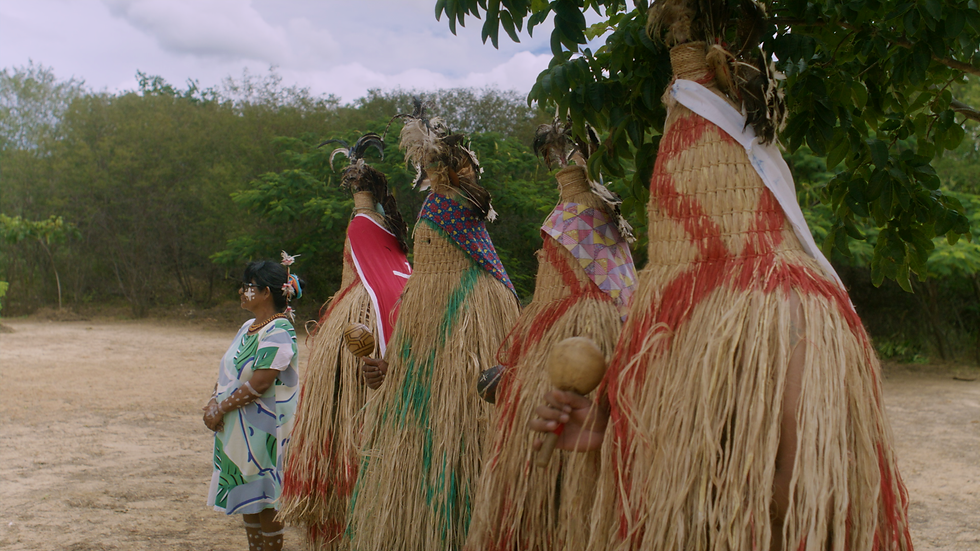
The film unfolds through daily life, rituals, assemblies, and moments of intimacy. It reveals the beauty of the forest, the strength of ancestral knowledge, and the tensions that define contemporary Brazil. Rather than offering closure, To’a Kaninã leaves the audience with an open question: is there still time to dream of a world that does not end?

Creative Process
The documentary will be built through an observational cinema approach, interwoven with moments of narration by the main protagonists. The central structure of the film will be shaped from the perspective of Cleonice and Uakyrê, mother and daughter, who embody the past and the future of Indigenous resistance. Pankararu and Pataxó cosmology will be present not only in the direct cinema scenes and in the protagonists’ narration, but also in the many sounds that will compose the film’s sonic universe.
The film will follow the daily lives of Cleonice, her daughter Uakyrê, and the people of the Cinta Vermelha Jundiba village, observing their routines, customs, and rituals. We will also document the political processes surrounding the struggle for land demarcation and their efforts to halt the advance of mining in the region. All scenes will be filmed through an observational lens. Our crew will be small, aligned, quiet, and attentive, seeking minimal intervention and allowing situations to unfold organically.
Interviews will be conducted as a foundation for the narrative texts that will later shape the moments of voice-over. After filming, these interviews will be transcribed, carefully edited, and re-recorded in studio by the protagonists themselves. Under the guidance of the directors, regarding tone, cadence, and vocal inflection, the narration will be crafted to convey not only meaning but also the emotional texture of each scene.
Cinematography will play a central role in the film, emphasizing the contrast between the natural landscapes of the Jequitinhonha Valley, the poetic dimension of Indigenous culture, and the transformations imposed by mining. Long, contemplative takes will reveal both the beauty of the land and the monumental scale of mining waste. During rituals and celebrations, the camera will move with sensitivity, capturing moments of enchantment in a playful yet respectful way. Light, gestures, textures, and subtle color treatments will mark the passage between worlds, inviting the audience to cross the boundaries of the visible and to experience the sacred vitality that pulses through these territories.
Sound design will be essential in shaping the film’s atmosphere. The Pankararu toantes, Pataxó chants, and the layered sounds of the forest will create a sonic landscape that contrasts with explosions, the constant hum of machinery, and the mechanical presence of extraction. This tension between nature and industry, life and destruction, will guide the editing process.
The montage will follow a dialectical structure, revealing the contradictions and conflicts that define this territory. Through this interplay, the film will illuminate not only the present moment, but also the futures being imagined and contested.
Director's note
For us, this is a documentary distinguished by both its aesthetic and political ambition. To tell the story of Cleonice Pankararu, To’a Kaninã, is to tell part of Brazil’s history, a profound Brazil that rarely appears on our screens. Her life offers a portrait of multiple phases of Brazilian history. It begins in the sertão of the Northeast during the military dictatorship, a harsh period that remains insufficiently addressed in our country, especially when compared to other nations that have faced similar authoritarian regimes. To this day, Brazil lacks films that portray the impact of the dictatorship on Indigenous peoples, leaving a gap in our collective memory.
Cleonice’s story crosses the period of redemocratization and reaches the present moment, marked by climate crisis and the urgent need to rethink extractive models. Her trajectory reveals the persistence of colonial structures that we must confront if we wish to continue existing in this world. When we look at the grey desert left behind by lithium mining in the Jequitinhonha Valley, sustained in the name of progress, we understand that it is not only this region that is under threat. This grey desert will spread across every territory on the planet where rare earth minerals are found. We cannot normalize a future in which everything turns grey. We all share responsibility for understanding what we consume, the lifestyle we sustain, and the price paid for it. We are all implicated.
We want to make this film because the lithium mining promoted by large multinational corporations, as portrayed in this film, is not merely an environmental issue. It is a matter of life, memory, and future.
The future is a vital force that moves us, and in this film it takes shape through Uakyrê, Cleonice’s daughter. She helps narrate this story and represents not only the present but also the tomorrow of Indigenous struggle and resistance.
When speaking about Indigenous peoples, Brazilian audiovisual narratives often focus on Amazonian communities, particularly those of the Xingu region, overlooking the fact that Brazil is a continental country with approximately 391 Indigenous peoples who speak around 295 different languages. By repeatedly portraying only Amazonian groups, we render other Indigenous cultures invisible. This film seeks to widen that lens.
It is also important to note that Cleonice’s story reached each of us at different moments, even before the film began. For Renata Tupinambá, it emerged within spaces of Indigenous political struggle and was materialized in her artistic work Tape Nhe’eng, Path of Words, at the Inhotim museum. For Fernanda, it arrived through research spaces focused on human rights, particularly on rights violations caused by mining. The fact that the same woman crossed our paths independently at different times revealed the strength of her story and awakened in us the desire to tell it.
Director
Fernanda Amim and Renata Tupinambá
Fernanda Amim is a director, screenwriter, and producer. She studied documentary directing at the Brazilian Association of Cinematography (ABC) and trained in screenwriting at Roteiraria. She worked with Maria Augusta Ramos on the acclaimed documentary The Trial (O Processo) and was part of the research team for the documentary series Negro Muro, produced by Cardume Filmes for GNT Channel. She is a partner at Cardume Filmes and the director and writer of Misidentifed (Reconhecidos), selected for DocLab/DocSP (2021), produced with funding from RioFilme and SECEC/RJ. The film had its World Premiere at It's All True 2025, Première Brasil at 27th Rio de Janeiro Int'l Film Festival 2025, and won Best Documentary at the 18th LABRFF.
misidentified_2025

Director
Renata Tupinambá
Renata Tupinambá is a director, screenwriter, and artist. Since 2005, she has been dedicated to promoting Indigenous cultures through art, cinema, and Indigenous communication. She directed and wrote the audio series IAWARA, produced by Alice Braga, narrated by Wagner Moura and Lázaro Ramos. She is the screenwriter of the award-winning series Sou Moderno, Sou Índio (Cine Brasil TV), screenwriter and consultant of the miniseries Histórias (Im)Possíveis (TV Globo), and co-writer of TARÃ (Disney+, 2026). She served as Associate Curator at MASP and was an artist affiliated with the Inhotim Museum.
